Generative AI in Creative Industries
Generative AI is revolutionizing creative industries by introducing unprecedented automation and innovation in workflows. This article explores how AI tools are reshaping content creation, design, and production while addressing emerging risks like ethical concerns, copyright issues, and workforce impacts. We delve into both the transformative opportunities and the challenges that come with this technological shift.
The Rise of Generative AI in Creativity
The creative process, long romanticized as a uniquely human endeavor, has entered an unprecedented era of technological augmentation. The rise of generative AI marks a fundamental shift, not as a sudden revolution but as the acceleration of a long-brewing convergence of computation and art. Early algorithmic and procedural generation in music and graphics laid the groundwork, but the breakthrough came with deep learning architectures like transformers and diffusion models. These technologies, trained on vast corpora of human-created text, images, and sounds, learned the underlying “grammar” of creativity itself.
Key models have rapidly become cultural touchstones. GPT and its successors demonstrated an uncanny mastery of linguistic style and narrative structure, while DALL-E, Midjourney, and Stable Diffusion translated textual prompts into stunning, high-fidelity visuals. This capability enabled a new form of expression: conceptual prompting, where the artist’s skill partially shifts from manual execution to the iterative refinement of language and idea. The immediate effect was a dramatic democratization; anyone with a vivid imagination and a subscription could generate professional-grade illustrations, musical compositions, or marketing copy in seconds.
This rapid adoption triggered a spectrum of initial industry reactions, from euphoric experimentation to profound anxiety. Many traditionalists decried the automation of craft, fearing a devaluation of skill. Simultaneously, forward-thinking creatives saw a powerful new collaborator—a boundless source of inspiration and a tireless assistant for overcoming the blank page. This tension between threat and toolset defined the early discourse, setting the stage for a fundamental reorganization of the creative workflow itself, a transformation we will examine next.
Transforming Creative Workflows
Building on the foundational adoption of these tools, their true impact is realized in the profound restructuring of daily creative workflows. Generative AI is no longer a novelty but an integrated layer in the creative stack, fundamentally altering the stages of idea generation, prototyping, and content iteration.
In advertising, an art director might use a text-to-image model to generate hundreds of visual concepts for a campaign in minutes, moving from a vague brief to a rich mood board almost instantly. This rapid idea generation phase allows teams to explore a wider creative territory before committing. In film pre-production, tools like RunwayML or Pika Labs enable directors to create dynamic prototyping shots or storyboards from text, visualizing complex scenes without costly physical sets or early VFX bids. Game developers leverage AI to rapidly generate environmental textures, concept art for characters, or even snippets of dialogue, creating iterative assets that can be tested and refined in-engine.
The core transformation lies in the automation of repetitive, labor-intensive tasks. This includes rotoscoping in video, generating asset variations for A/B testing, or scoring placeholder music. By handling this “digital grunt work,” AI tools free creatives from technical constraints, allowing a sharper focus on narrative, emotional resonance, and higher-level innovation—the uniquely human domains of strategic vision and nuanced taste. This efficiency directly translates to accelerated production timelines and significant cost reduction, particularly in prototyping and asset creation phases. However, this streamlined workflow introduces new complexities in project management, asset provenance, and the need for a critical, editorial human eye to guide the iterative process, setting the stage for examining the collaborative partnership itself.
Enhancing Collaboration Between AI and Humans
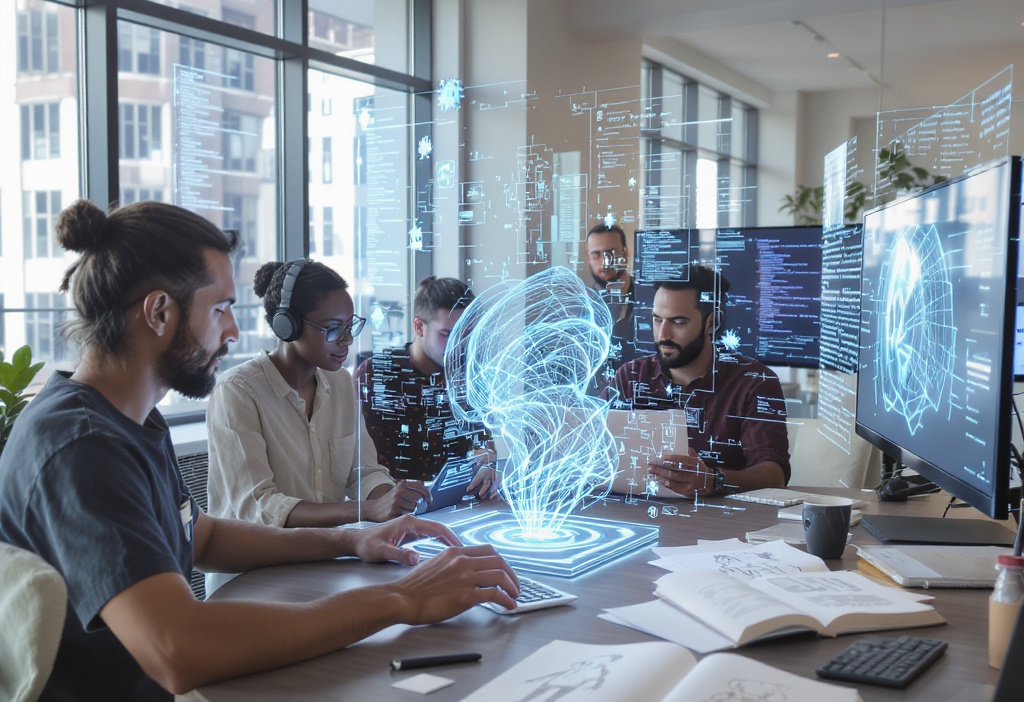
Building on the transformed workflows, the true potential emerges not from replacement, but from a symbiotic partnership. Generative AI evolves from a productivity tool into a collaborative partner, augmenting human imagination rather than automating it away. This partnership thrives on a dynamic exchange: the AI offers a vast, often surprising, array of possibilities—unconventional color palettes, melodic variations, or narrative twists—while the human creative provides the intentionality, emotional depth, and contextual judgment that the system lacks.
The core of this collaboration is the balance between AI-generated suggestion and human-led curation. In film, tools like Runway ML allow directors to rapidly visualize complex scenes, but the final aesthetic and narrative cohesion remain a human directive. In music, artists like Holly Herndon use AI to generate novel vocal textures, which she then intricately composes and edits, maintaining her distinctive artistic voice. This process underscores that groundbreaking work arises when AI handles combinatorial exploration at scale, freeing humans to focus on meaning-making and strategic creative direction.
Maintaining this balance requires vigilant creative control and ethical oversight. The human must remain the editor-in-chief, critically assessing AI outputs for alignment with vision and values. This oversight is crucial to prevent the erosion of unique human expression into a homogenized, algorithmically-pleasing median. As we delegate more of the generative process, establishing clear frameworks for authorship and responsibility becomes paramount, a necessary bridge to the forthcoming discussion on the ethical foundations that must underpin this entire collaborative endeavor.
Ethical Implications and Bias in AI Outputs
While the previous chapter explored the potential for harmonious AI-human collaboration, this partnership is fraught with a fundamental ethical challenge: the bias inherent in AI systems. Generative AI models are not neutral; they are mirrors of their training data, which is often vast, uncurated, and reflective of historical and societal inequities. When creatives integrate these tools into their workflows, they risk unconsciously importing and amplifying these biases, leading to outputs that perpetuate stereotypes, lack fair representation, or generate outright harmful content.
The core issue is that bias in training data leads to skewed or harmful outputs. A model trained predominantly on Western art may fail to generate authentic cultural motifs. A text-to-image generator might default to stereotypical representations of professions or genders. This not only produces ethically questionable work but also erodes the diversity of creative expression, reinforcing a narrow, homogenized view of the world. The risk is particularly acute when AI is used at scale, potentially cementing these biases into mainstream media and advertising.
Addressing this requires proactive frameworks for ethical AI use. Creatives and studios must move beyond treating AI as a “black box.” Key mitigations include:
- Demanding Transparency: Understanding a tool’s data sources and limitations is the first step toward critical use.
- Prioritizing Diverse Datasets: Advocating for and using models built on inclusive, representative data is crucial.
- Implementing Human-in-the-Loop Oversight: The ethical oversight discussed earlier must explicitly involve auditing outputs for bias, not just aesthetic quality.
Ultimately, the creative’s responsibility extends to the ethical implications of their tools. This foundational concern with bias and fairness directly sets the stage for the next critical issue: the intellectual property of these ethically complex, AI-assisted creations.
Intellectual Property and Copyright Concerns
The ethical challenges of bias and representation are intrinsically linked to the legal quagmire of intellectual property. If an AI’s output is skewed by its training data, who owns—and is liable for—that output? The current copyright framework, built on human authorship, struggles to accommodate AI-generated works.
Ownership remains the core ambiguity. Most jurisdictions, including the U.S. Copyright Office, maintain that works lacking human authorship cannot be copyrighted. This creates a potential “ownership vacuum” for purely AI-generated assets. However, a significant gray area exists for human-AI collaborations, where copyright may protect the human-curated elements.
Infringement risks are pervasive. AI models trained on copyrighted works without licenses risk producing outputs that are derivative or substantially similar to protected works. Legal precedents are still forming. Cases like Andersen v. Stability AI question the “fair use” defense for massive-scale training, while rulings on AI-assisted comic books have denied copyright for AI-generated images.
Best practices for creatives are evolving. To protect original work:
- Maintain meticulous records of human creative direction and iterative refinements to AI outputs.
- Use tools with clear, licensed training data or opt for models trained on owned or public domain content.
- Implement robust attribution and contractual clarity when AI is part of a commercial workflow.
This unresolved legal landscape directly sets the stage for economic disruption, as uncertainty over ownership and liability influences investment, job roles, and market value for creative output.
Economic Impacts on Creative Jobs
Following the legal ambiguities of ownership, the direct economic consequences for creative professionals are coming into sharp focus. Generative AI is not a monolithic job destroyer but a powerful force reshaping the demand for specific skills, leading to significant workforce dislocation and transformation.
Current trends indicate a clear displacement effect for roles centered on execution and volume production. Entry-level graphic design for marketing assets, stock content creation, and routine copywriting are increasingly automated, compressing traditional career pathways. Data from industry surveys suggests a contraction in demand for these positions, pressuring wages and forcing a rapid pivot up the value chain.
Conversely, new hybrid roles are emerging at the intersection of creativity and technology. The demand for AI trainers and prompt engineers—specialists who can curate datasets and craft nuanced instructions to steer AI outputs—is rising. Furthermore, the ethical and legal complexities discussed previously fuel the need for AI ethics specialists and AI workflow managers who can oversee responsible implementation and integrate AI tools into coherent production pipelines.
The net economic impact hinges on adaptation. The future creative workforce will likely be smaller in traditional roles but more specialized, requiring professionals to master AI collaboration. This underscores a critical need for systemic reskilling, moving from pure execution to high-level conceptualization, editing, and ethical governance of AI-generated material. This evolution sets the stage for the next challenge: ensuring the quality and authenticity of the content these new workflows produce.
Quality Control and Authenticity Issues
Following the economic shifts reshaping creative employment, a more subtle but equally profound challenge emerges: the erosion of quality and authenticity in AI-assisted outputs. The efficiency gains highlighted previously carry an inherent risk—the homogenization of creative content. Trained on vast, existing datasets, generative AI models often produce work that averages towards the mean, lacking the idiosyncratic spark, cultural nuance, and intentional imperfection that define a unique artistic voice. This can lead to a market flooded with technically proficient but emotionally sterile and derivative material.
Maintaining quality requires moving beyond treating AI as an autonomous creator. A robust human-in-the-loop review process is non-negotiable. This is not merely a final check, but an integrated, iterative collaboration where the human creative directs, critiques, and selectively edits AI-generated drafts. The most effective method is a hybrid workflow that strategically blends AI efficiency with human creativity. For instance:
- AI handles rapid prototyping and generating base-layer assets.
- Human artists provide the core creative vision, make critical aesthetic judgments, and inject personal experience and emotional depth.
- Final outputs undergo rigorous curation to ensure they meet brand and artistic standards of originality.
This approach mitigates the risk of losing authentic expression, ensuring the final product reflects a human perspective rather than a statistical model’s approximation. However, as we seek to preserve authenticity, we must also confront those who would weaponize these tools to fabricate it entirely, a danger that leads directly to the next critical issue.
Security Risks and Misuse of AI Tools
Building on the need for human oversight to preserve authenticity, the proliferation of generative AI introduces profound security risks and vectors for misuse that extend beyond artistic integrity to societal harm. The very tools that empower creators can be weaponized by malicious actors, demanding a new paradigm of defensive vigilance.
A primary threat is the creation of hyper-realistic deepfakes—synthetic audio, video, or imagery that falsely depicts individuals. In creative industries, this enables unauthorized content generation, such as placing an actor in a scene without consent or generating a musician’s voice to perform new works, constituting severe violations of personality rights and intellectual property. This capability dovetails dangerously with coordinated misinformation campaigns, where synthetic media is used to fabricate events or statements, eroding public trust and manipulating markets or public opinion.
Combating these risks requires a multi-layered approach:
- Technological Safeguards: Developing robust provenance standards, like cryptographic watermarking and content credentials (e.g., C2PA), to trace AI-generated media origin. Detection tools must also evolve, though this remains an arms race.
- Regulatory Actions: Legislators must clarify liability and create specific offenses for harmful deepfakes, complementing broader frameworks discussed in the next chapter. Laws must deter misuse without stifling legitimate creative tools.
- Industry Standards: Platform policies mandating disclosure, developer ethics in API access, and collective agreements on ethical use are critical. This self-regulation, coupled with public literacy on synthetic media, forms a crucial societal buffer.
Fostering responsible innovation thus hinges on embedding security-by-design into AI tools, ensuring the creative potential of generative AI is not undone by its capacity for deception and harm.
Regulatory and Legal Frameworks
Following the examination of direct security threats, the creative sector must now navigate the complex and evolving regulatory and legal frameworks emerging to govern generative AI. These frameworks aim to institutionalize the preventive measures discussed earlier, moving from voluntary safeguards to enforceable obligations.
The EU AI Act is the most prominent example, establishing a risk-based regulatory regime. For creative industries, its implications are profound. It classifies certain AI systems used in creative contexts—like emotion recognition or biometric categorization—as high-risk, subjecting them to stringent requirements for transparency, data governance, and human oversight. More broadly, it mandates clear labeling of AI-generated content, directly addressing the deepfake and misinformation risks from the previous chapter. Creators and businesses must now maintain detailed documentation on training data and model processes, impacting workflow agility and raising compliance costs.
Beyond hard law, industry self-regulation is shaping norms. Initiatives like the Content Authenticity Initiative (CAI) promote technical standards for provenance and watermarking, creating a parallel layer of accountability. However, the global nature of digital content necessitates international cooperation. Divergent approaches between the EU, US, and Asia create a patchwork that complicates distribution and monetization. The central challenge for policymakers is crafting rules that protect intellectual property and individuals from harm—without stifling the experimental, iterative processes fundamental to creativity. This legal scaffolding must be robust enough to mitigate risks, yet flexible enough to accommodate the rapid, unpredictable innovation that will define the future trends to come.
Future Trends and Innovations
Following the establishment of legal guardrails, the creative industries can now look toward a horizon of accelerated, yet more accountable, innovation. The next frontier lies in real-time AI collaboration, where generative models evolve from static tools into dynamic creative partners. Imagine a composer adjusting a musical phrase and an AI instantly offering harmonically coherent variations, or a 3D animator sculpting a form while an AI suggests biomechanically plausible textures and movements in a fluid feedback loop. This will collapse iteration cycles from days to minutes, fundamentally altering the creative dialogue between human intuition and machine execution.
Concurrently, personalized content generation will move beyond simple recommendations to the on-demand synthesis of unique creative works. A user could generate a bespoke animated short featuring their likeness in a specific artistic style, or a video game that dynamically restructures its narrative around their emotional responses. This hyper-personalization presents immense opportunities for audience engagement but also introduces profound risks around data privacy, psychological profiling, and the potential erosion of shared cultural experiences.
These trends will demand new workflows centered on AI curation and direction rather than manual creation, shifting the premium skill to creative vision and critical editing. The risks, however, are significant: real-time collaboration raises acute questions about provenance and contribution tracking, complicating the legal frameworks discussed earlier. Personalized generation could further blur the lines of copyright and lead to new forms of algorithmic bias. To foster sustainable and inclusive practices, the industry must leverage these tools to lower barriers to entry while actively developing audit systems for AI-generated content and ensuring diverse datasets train the models that will shape our future cultural landscape.
Conclusions
Generative AI is reshaping creative industries with enhanced workflows and novel risks. By embracing ethical practices, robust legal frameworks, and human-AI collaboration, we can harness its potential while mitigating challenges. The future hinges on balancing innovation with responsibility to foster a thriving, equitable creative ecosystem.