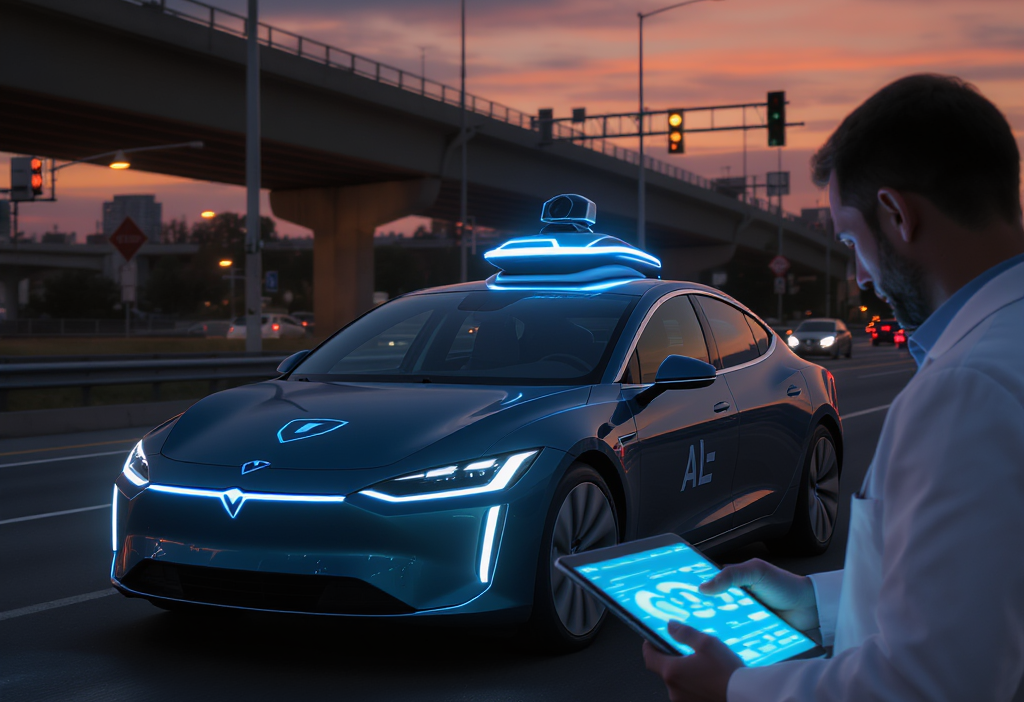
Autonomous Vehicles and AI Safety The Essential Proofs Before Trust
As autonomous vehicles transition from concept to reality, establishing trust requires more than technological demonstration. This article explores the critical proofs needed across safety, ethics, and reliability before society can confidently embrace self-driving cars. We examine the multifaceted validation process that must precede widespread adoption and public acceptance of AI-driven transportation.
The Current State of Autonomous Vehicle Technology
The promise of a fully autonomous vehicle remains just that—a promise. Today’s reality is a fragmented landscape of partial automation, where the burden of vigilance and ultimate responsibility largely remains with the human driver. This is codified by the Society of Automotive Engineers (SAE) Levels of Driving Automation, which serve as the industry’s crucial framework. The vast majority of commercially available systems, like Tesla’s Autopilot or GM’s Super Cruise, operate at Level 2 (combined automated functions like steering and acceleration with driver supervision). A handful of Level 4 systems—capable of full autonomy within a specific Operational Design Domain (ODD)—are deployed, but only in tightly geofenced and often heavily mapped commercial ride-hailing services, such as Waymo in Phoenix and San Francisco or Cruise (prior to its 2023 suspension) in San Francisco.
The core technological gap lies in the chasm between controlled testing environments and the unbounded complexity of the real world. Leading systems demonstrate remarkable proficiency in routine scenarios within their ODD, handling traffic lights, pedestrians, and other vehicles with increasing smoothness. However, their performance degrades rapidly when faced with edge cases: construction zones with临时 signage, erratic human drivers, or adverse weather conditions like heavy rain or snow that obscure sensor data. This limitation is why all current deployments are geographically constrained and rely on extensive pre-mapping—a crutch that highlights the system’s inability to achieve true generalized perception and reasoning.
This state of technology directly sets the stage for the next critical question: if our vehicles are neither fully manual nor fully autonomous, how do we define and measure their safety in this hybrid reality? The industry’s current capabilities expose the profound difficulty of moving from demonstrating competence in millions of miles of mostly uneventful driving to proving safety for the one-in-a-billion catastrophic scenario, a challenge that existing automotive safety metrics are ill-equipped to solve.
Defining Safety in Autonomous Systems
Building upon the current technological landscape, establishing a rigorous, multi-dimensional definition of safety is the foundational challenge. For autonomous systems, safety cannot be a single metric but a composite of functional safety (freedom from unreasonable risk due to system failure) and safety of the intended functionality (absence of unreasonable risk from performance limitations, even with a “functioning” system).
Traditional automotive safety relies heavily on:
- Reactive, statistical metrics like fatalities per 100 million miles.
- Component-level validation against standards like ISO 26262 for hardware and software faults.
These are necessary but insufficient for AI-driven vehicles. New, AI-specific requirements demand proof of robustness in perception and decision-making across an infinite-tail distribution of scenarios. The core challenge is the edge case: the rare, unpredictable event for which there is little to no training data. Proving safety here moves beyond statistical validation, as demonstrating a failure rate equivalent to a human driver (e.g., 1 fatal accident per ~100 million miles) would require tens of billions of real-world test miles—a practical impossibility.
This necessitates a shift towards argumentation-based assurance, constructing a logical safety case that synthesizes evidence from:
- Disciplined scenario-based testing
- Formal verification of critical subsystems
- Simulation of rare events
The limitation is that the completeness of this safety case is unprovable; we cannot simulate every possible world state. Therefore, defining safety becomes an exercise in bounding uncertainty and demonstrating a measurably lower risk profile than human drivers across a validated Operational Design Domain, setting the stage for the intensive technical validation processes required to gather this evidence.
Technical Validation Through Simulation and Testing
Building on the definition of safety as a multi-dimensional, statistically-driven goal, we must now address the monumental task of technical validation. Proving an AI-driven vehicle is safe requires evidence from two interdependent domains: simulated and physical testing, each compensating for the other’s limitations.
Simulation is the cornerstone for exploring the “long tail” of rare events. It allows for the systematic exposure of the driving AI to billions of scenarios, including catastrophic edge cases too dangerous for real roads. The core challenge is fidelity—creating a digital world with physically accurate sensor models, realistic agent behavior, and complex environmental dynamics. Without this, the AI may learn behaviors that fail in reality, a phenomenon known as simulation bias.
However, simulation alone is insufficient. Controlled real-world testing on closed courses and public roads (with safety drivers) provides irreplaceable data on vehicle performance in truly unpredictable conditions. It validates sensor performance under real noise and tests the AI’s interaction with human drivers and pedestrians. The key is not merely accumulating millions of miles, but ensuring those miles are diverse and challenging.
These methods are complementary: simulation provides breadth and stress-testing; real-world testing provides depth and ground truth. Determining sufficiency is a statistical challenge. Metrics move beyond simple mileage counts to:
- Disengagement rates per critical scenario category.
- Scenario coverage against a predefined ontology of driving situations.
- Performance thresholds met across a validated set of simulation and real-world test suites.
Validation concludes not when failures cease, but when the residual risk is statistically demonstrable as lower than a human benchmark. This rigorous technical proof sets the stage for the next layer of assurance: ensuring the vehicle’s physical sensors can reliably perceive the complex world this testing has validated.
Sensor Reliability and Environmental Adaptation
Following the rigorous validation of software and systems in simulated and controlled environments, we must now confront the physical reality of perception. An autonomous vehicle’s understanding of the world is entirely mediated by its sensor suite—cameras, LiDAR, radar, and ultrasonics. Each has critical failure modes: cameras are blinded by glare or heavy precipitation; LiDAR scatters in fog; radar struggles with static object discrimination. Therefore, trust demands proof of operational robustness across the entire environmental envelope.
Reliability is not about perfect performance of individual sensors, but guaranteed system-level perception through heterogeneous redundancy. This means layering modalities so the failure of one is compensated by another’s physical principle. For example, while LiDAR may fail in a snowstorm, radar can still track objects. The core challenge is sensor fusion—algorithmically synthesizing these disparate, noisy, and sometimes contradictory data streams into a single, coherent, and accurate world model in real-time.
The vehicle must also demonstrate adaptive fault tolerance. This includes:
- Dynamic confidence weighting of sensor inputs as conditions change.
- Graceful degradation strategies when a sensor fails, triggering operational design domain (ODD) limitations or safe stop protocols.
- Detection of adversarial conditions, like deceptive road markings or concentrated LiDAR jamming, and appropriate response.
Ultimately, the vehicle must prove it can not only sense the world reliably but also sense that its own sensing is becoming unreliable, a meta-cognitive capability crucial for handling the unexpected. This proven environmental adaptation forms the bedrock of perceptual trust, upon which the next layer—the vehicle’s decision-making logic and ethical calculus—must be built.
Decision-Making Algorithms and Ethical Considerations
While a vehicle’s sensors, as discussed, provide a perception of the world, the decision-making algorithms form the vehicle’s cognitive core, interpreting that data into action. This layer must move beyond basic obstacle avoidance to navigate the profound ethical complexities of real-world driving.
These algorithms operate on a hierarchy of objectives: safety, legality, and efficiency. However, conflicts are inevitable. In a critical scenario—a sudden obstruction with only harmful paths available—the system must execute a predefined ethical cost-function. This is not about programming a car to “solve” the trolley problem, but about transparently encoding priorities: minimize overall risk, avoid vulnerable road users, and maintain predictable control. The public trust crisis emerges from the opacity of these calculations. We must move from a “black box” to an explainable AI framework, where a vehicle can log and justify its decisive trajectory, not just the sensor input.
Furthermore, these systems face moral ambiguity in routine decisions. Is it acceptable to slightly cross a lane marker to give a cyclist more space? How should the vehicle weigh the urgency of an ambulance behind it against oncoming traffic? Programming requires consistent, verifiable frameworks that translate societal norms into code, a task fraught with philosophical and technical difficulty. This establishes the foundational logical integrity that must be secured before addressing external threats, as a perfectly secure system making unethical decisions remains fundamentally unsafe.
The validation of these algorithms demands more than miles driven; it requires proof of ethical robustness through exhaustive simulation of edge-case scenarios, demonstrating that the vehicle’s choices align with a publicly scrutinized and legally sound value system. This forms the critical bridge from physical sensing to the secure digital fortress that must protect these very decisions from malicious compromise.
Cybersecurity and System Integrity
Following the discussion of ethical decision-making, we must address a more foundational threat: the potential for those very algorithms to be subverted. Cybersecurity is not an added feature for autonomous vehicles (AVs); it is the bedrock of their operational integrity. Proving safety means proving resilience against malicious actors seeking to compromise vehicle systems.
The attack surface is vast. Vulnerabilities exist within the vehicle’s internal Controller Area Network (CAN bus), sensor suites (LiDAR, cameras), and the complex AI inference engines themselves. External threats target communication networks—V2X (vehicle-to-everything) links—and infrastructure interfaces, enabling fleet-scale attacks like spoofed traffic signals or coordinated denial-of-service.
To earn trust, the industry must demonstrate a zero-trust architecture with provable security properties. This requires:
- Cryptographic Agility: Beyond strong encryption, systems need secure, over-the-air update protocols to rapidly respond to new threats without creating new vulnerabilities.
- Anomaly Detection at Multiple Layers: Intrusion Detection Systems (IDS) must monitor not just network traffic but also physical sensor data and AI decision logic for inconsistencies suggesting manipulation.
- Fail-Secure and Isolated Recovery: A compromised vehicle must have predefined, hardware-enforced safe states (like a controlled stop). Critical driving functions must be isolated from infotainment systems, with immutable recovery protocols to restore a known-good state.
Ultimately, proving system integrity means demonstrating that the vehicle can maintain functional safety under attack. The ethical frameworks discussed previously are meaningless if a malicious actor can alter them or feed the vehicle corrupted perception data. This proven resilience forms the essential technical prerequisite for the next challenge: designing clear human-machine interfaces and handover protocols for situations where, whether by cyberattack or system limit, human intervention is required.
Human-Machine Interaction and Handover Protocols
Having established the need for robust cybersecurity and system integrity, we must now address the human element within this secure shell. The vehicle’s safety is not solely defined by its resistance to external attack, but by the clarity and reliability of its interaction with its human occupants and other road users. This human-machine interaction (HMI) is a critical safety layer in itself.
The vehicle must communicate its intentions and operational status unambiguously. Internally, this means intuitive displays indicating the driving mode, perceived objects, and planned maneuvers. Externally, it requires standardized vehicle-to-pedestrian (V2P) signals—like light projections or displays—that convey “yielding” or “proceeding” to replace the nuanced language of human drivers.
More critical is the design of handover protocols for situations where the system reaches its operational limits or encounters a failure. This is not a simple alarm. It is a carefully timed process that must:
- Diagnose the urgency and calibrate the warning escalation accordingly.
- Provide adequate lead time for the human to achieve situational awareness, a cognitive process that can take 8-15 seconds under ideal conditions.
- Present contextual information (e.g., “taking control due to obscured lane markings ahead”) rather than a generic alert.
Proving safety here means demonstrating that the system can not only detect the need for handover but also assess the driver’s readiness—via eye-tracking or hands-on-wheel monitoring—and, if readiness is insufficient, execute a minimal risk maneuver to stop safely. This handover challenge underscores that technical validation is insufficient without ergonomic and psychological validation, a foundation necessary for the regulatory frameworks discussed next.
Regulatory Frameworks and Certification Processes
Building on the critical human-machine interface, the vehicle’s operational safety must be formally validated by external authorities before public deployment. The regulatory landscape for autonomous vehicle (AV) approval is a fragmented, evolving patchwork, struggling to keep pace with AI’s unique characteristics. Unlike traditional automotive safety, which relies on predictable mechanical performance, AV certification must grapple with the probabilistic nature of AI decision-making in an open-world environment.
Current certification processes, like the UN’s type-approval framework or the U.S. DOT’s voluntary guidance, are being retrofitted for automation. They primarily address the vehicle’s physical safety and basic system functions. The core challenge is developing standards for safety of the intended functionality (SOTIF) for AI-driven perception and planning. International bodies like ISO and SAE are developing crucial standards (e.g., ISO 21448 for SOTIF, ISO 8800 for AI safety) that aim to create a common language for validation, focusing on scenario-based testing, simulation, and operational design domain (ODD) definition.
Jurisdictions balance innovation and safety differently. Some, like certain U.S. states, employ a permissive, innovation-first approach with minimal pre-market regulation, relying on post-deployment monitoring. Others, like the EU under its proposed AI Act and new vehicle regulations, are adopting a more precautionary principle, demanding extensive evidence of AI system robustness, cybersecurity, and data governance before approval. All face the dilemma of regulating a “learning” system, as a vehicle certified at launch may evolve through software updates—a bridge to the next chapter’s focus.
Ultimately, trust requires a regulatory shift from certifying a static product to approving a dynamic, data-driven safety assurance process. This involves continuous audit trails for AI behavior, standardized safety performance metrics, and regulatory access to driving data and simulation environments to independently verify claims. The goal is a framework that proves not just that the vehicle is safe today, but that its developer’s processes ensure it will remain safe as it learns and the world changes.
Data Collection and Continuous Learning Systems
Following the establishment of regulatory frameworks, the operational reality of an autonomous vehicle (AV) hinges on its data collection and continuous learning systems. Unlike certified, static software, these vehicles operate on adaptive artificial intelligence that must evolve through exposure to real-world driving. This creates a fundamental safety paradox: the system must change to improve, yet every change introduces potential risk.
The process begins with the massive, continuous ingestion of sensor data—lidar, radar, camera feeds—from global fleets. This data is analyzed to identify edge cases: rare or unforeseen scenarios like unusual road debris, complex weather interactions, or erratic human driver behavior. Machine learning models are then retrained on these new examples, aiming to generalize better for future encounters.
The critical safety challenge lies in the validation of these updates. Regulators may have certified Version 1.0, but how is Version 1.1 assured? This requires:
- Rigorous virtual and closed-course testing of updates against exhaustive scenario libraries before deployment.
- Shadow mode deployment, where the new software runs in parallel without vehicle control, comparing its decisions to the old system and the human driver.
- Staged, geofenced rollouts to monitor performance in limited, well-understood environments.
A paramount concern is catastrophic forgetting or unintended behavioral drift, where learning from new data degrades performance on previously mastered tasks. Furthermore, the feedback loop itself must be safeguarded; corrupted or maliciously injected training data could deliberately create vulnerabilities. Therefore, proving safety is no longer a one-time event but requires demonstrating control over a continuously learning lifecycle, where the integrity, validation, and traceability of every update are as crucial as the initial certification. This technical proof of controlled evolution is a prerequisite for the public trust discussed next.
Public Perception and Trust Building
While the previous chapter detailed the technical mechanisms for safety—continuous data ingestion and validated software evolution—these systems remain abstract to the public. Trust is not a software certificate; it is a psychological and social construct built on perceived competence, transparency, and shared values.
Public perception forms through a potent mix of direct experience, media narratives, and the transparency of operating logic. When an AV behaves unpredictably, even if safely, it erodes trust. Therefore, demonstrating safety statistically is insufficient. The “why” behind decisions must be communicated. This goes beyond disclosing miles driven; it requires intelligible explanations of capability boundaries and how the vehicle prioritizes actions in complex dilemmas.
Incidents catastrophically impact confidence because they make abstract risks visceral. Recovery requires:
- Radical transparency: Immediate, clear communication of incident data, probable causes, and corrective actions, avoiding defensive legalese.
- Contextualizing risk: Honestly comparing performance to human drivers at a societal level, without appearing dismissive of specific tragedies.
- Human-centric design: Ensuring the vehicle’s behavior is not just safe but also comprehensible and predictable to other road users and passengers.
Long-term trust demands embedding safety culture into the social fabric. This involves independent, public auditing of AI systems, standardized safety metrics across the industry, and involving communities in defining ethical parameters for decision-making. Ultimately, trust is earned when the public believes the technology is not only competent but also accountable and aligned with societal well-being, creating a foundation for the next chapter’s discussion on regulatory frameworks and liability.
Conclusions
Establishing trust in autonomous vehicles requires comprehensive proof across technical, ethical, and social dimensions. From rigorous safety validation to transparent decision-making and robust cybersecurity, each element must be demonstrably reliable. Only through this multifaceted approach can autonomous vehicles transition from promising technology to trusted transportation, earning the public confidence necessary for widespread adoption and societal benefit.